

Seven cheap tools that turn ten stolen minutes into real pages. Nothing here costs more than five dollars, and most of it is already somewhere in your house or car.
It was not yet six, and the car park outside the gym was empty except for me and one streetlight that would not stop flickering. The coffee in the cupholder had already gone lukewarm. I wanted to write a line that had been circling me for days, and the only thing within reach was a half-dead marker my son had left in the door pocket, the cap long lost, the ink almost gone. So I wrote with that. The marker skipped and ghosted across the page, and the words came out pale and scratchy and far braver than anything I had typed all month.
I made myself a quiet promise back in January 2025, to stop waiting for perfect conditions before I let a single word count. For years I believed I needed a clear desk, the right notebook, a settled mind, and that tidy morning kept not arriving. Between a full-time job, a family, and a newsletter I build in the gaps, the calm two-hour block I kept picturing was never coming for me.
So I stopped hunting for the time and started stealing it instead, with whatever was lying around. One Saturday letter began as three lines on a napkin in a drive-through queue, the paper going soft where my thumb pressed it. A whole essay opened with that dying marker. The writing came out messier and a little braver, and the strange part is that it also got finished.
Here is what I worked out slowly, over a lot of wasted mornings. The cheapness is the method, not a compromise I settled for. A thirty dollar leather journal sat on my shelf for a year, too lovely to spoil, while a supermarket notebook filled with rubbish, and buried in that rubbish was the good stuff.
Precious tools are where writing quietly goes to die.
The cheap, slightly silly ones lower the cost of starting until the excuses run out of room to stand. These are the seven I reach for again and again. Most of them you already own.

Catching the line before it disappears
1. A pack of half-dead markers (the ones your kid left in the car, yes, really)
Start with the most silly one, because it pulls more weight than anything else here. Find the markers your kid abandoned in the car, the half-dead ones that skip and ghost, and write your morning pages with those. A dying marker slows your hand and roughens every line.
Here is the part that surprised me. When nothing is at stake, the self-monitoring part of your brain, the inner editor that decides whether a sentence is allowed out, goes quiet. A scratchy marker dragging across a supermarket page reads to your nervous system as play rather than performance, and the editor stands down.
The tip stutters, the ink fading out mid-word, and somewhere in that stuttering the page stops pretending to be for anyone but you. I keep a handful in the car door for exactly the mornings when the blank page feels too serious to face.
2. Paper you would happily throw away (a few dollars, or free)
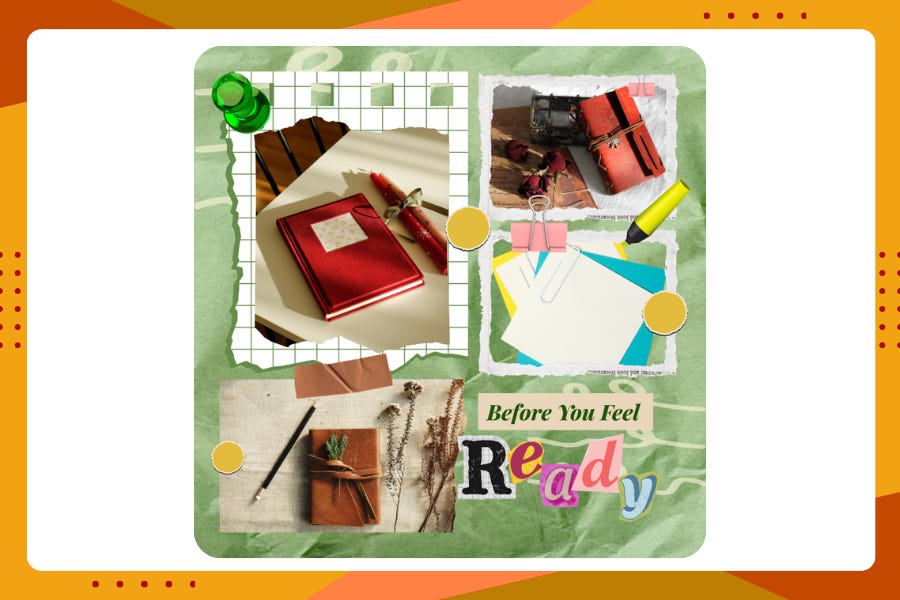
Buy the cheapest notebook you can stand to look at, then buy two more, and keep one in the car, another in your bag, a third by the bed. The whole trick is that it costs little enough to fill with nonsense. A beautiful notebook makes you freeze, because the first line has to earn the page. The supermarket one expects nothing of you, so you write the bad sentence, and the bad sentence is usually the one that quietly unlocks the good one.
When even that feels too formal, write on something already heading for the bin. A napkin, the back of a receipt, a flap torn off a cereal box. There is a strange freedom in scribbling on paper destined for the recycling, because none of it is dignified, and that is its whole strength. The back of a pizza flyer holds no opinion of you at all, so you stop auditioning and start saying the true thing. Catch the line, shove the scrap in your pocket, and copy the keepers into the cheap notebook later. Half of my favorite opening lines started life on something I would otherwise have thrown away.
💡 Quick tip: spend your money on the wrong end. A $3 notebook you will actually scribble in beats a $30 one you are scared to open. Save the lovely journal for copying out the lines that survived, and let the cheap stuff take the mess.
Drafting in the cracks
3. A pack of index cards (about $3 for a hundred)
The blank page asks you to know the whole shape before you begin. A single index card asks for one thought, and one thought is something you can manage in the four-minute wait outside the dentist. Your brain holds far less in working memory than the blank page silently demands of it, so shrinking the unit down to one card clears the overwhelm before it has a chance to start.
Write one idea per card and nothing more. The line you overheard in the school pickup queue, a scene you can still picture, the fact you keep wanting to use and never find a home for. Leave the order alone, because the order is the gift waiting at the end. Once you have a small stack, spread them across the kitchen table and shuffle them into a sequence, and the essay half-builds itself in front of you.
I draft almost everything this way now. Moving ten cards around a table feels like play. Sliding ten paragraphs around a screen makes me want to lie down.
4. One unfinished sentence (free)
Some mornings even a full card is too much to face. So do not start a sentence. Finish one. Write half a line and leave it dangling. The thing I keep circling is. If I were braver on the page, I would. What I really mean is. Now you are not starting, you are finishing, and your brain already knows how to finish.
A dangling half-line does the hardest ten percent for you, the part where most mornings quietly die.
I leave one waiting at the bottom of the page each night, so the next morning has a handhold before the coffee has even kicked in.
5. A $1 wind-up timer (not the one on your phone)
A wind-up timer does the one thing your phone never will. It starts the clock without opening a door to everything else behind the glass. Set it for ten minutes, write until it rings, and hold yourself to a single rule: nothing gets fixed until it does.
Ten minutes is too small a thing to be worth defending, so the part of you that guards the page never shows up to guard it. A short window reads as low-threat, and the perfectionist only ever arrives when the stakes feel high. The ticking helps more than I expected. It turns a vague wish to write into a small, finish-able race you can win before the kettle boils.
6. A pad of sticky notes (about $3)
Index cards are for the ten minutes you get to sit down. Sticky notes are for the days you get none. Write one beat of an essay per note, the point you mean to make, an image, the turn you are reaching for, then press them onto the bathroom mirror, the side of the fridge, the window above the sink.
Now the shape of the piece lives in front of you while you brush your teeth. You nudge one note half an inch to the left on your way past. Across a week of passing glances the order quietly sorts itself out, because your brain keeps chewing on a problem it can see long after you have walked away from the wall. Each pass earns one small rearrangement, and the structure builds while you are technically doing nothing.
💡 Quick tip: date every card and loose sheet in the corner. A stack of dated fragments becomes a quiet record of how the work actually built, one morning at a time. On the days it feels like nothing is happening, that growing pile is the proof that it is.
Proof it’s adding up
7. A shoebox (free, already at the back of your wardrobe)
Keep a shoebox somewhere you can see it, and feed it everything finished: the filled notebooks gone soft at the corners, the napkin drafts, the cards, the junk mail that turned, against all odds, into something true. It looks like nothing from the outside, a battered box of scraps you could mistake for rubbish. On the mornings you are certain none of this is adding up, lift the lid. There it is. Months of stolen minutes that quietly accumulated while you were busy doubting them.
Reinvention is rarely one brave leap. It is a box that slowly fills, one morning at a time.
On the hard days, that box argues with you far better than any pep talk ever could.
None of this is really about the tools. It is about shrinking the first step until it is too small to be worth dreading. You do not need the clear desk, the silent house, or the certainty that you are ready. What you need is a dying marker, ten stolen minutes, and the willingness to write badly until something true shows up.
Your pen was always the permission slip. Everything above is just a way of keeping one within reach.
I built this newsletter to nearly eight thousand readers on almost nothing but those stolen ten-minute windows in dark car parks. There is a method underneath the box of scraps, a way of turning scattered minutes into a body of work. It is called Future Scripting, and it begins exactly where this list does. Write it first. Live it second.
So here is the one thing worth doing today. Pick up whatever is within reach, a half-dead marker, a receipt, the back of your hand, and write the single sentence you have been waiting until you felt ready to write. You will not feel ready. Write it anyway. That sentence is the whole method in miniature, and the rest of Future Scripting just gives it somewhere to go.
For years I wrote those sentences alone, in a dark car park, wondering if any of it was landing. It does not have to be that solitary for you. Inside the Courage to Create Academy, a room full of stolen-moment writers shows up to do exactly this together, one small unready sentence at a time. If you would like company for yours, the door is open. Come and write with us.
What is the one sentence you have been putting off until you felt ready? Write it in the comments below. I read every single one.
Know someone with a drawer of beautiful empty notebooks she is too scared to ruin? Send her this, and tell her the dying marker is the whole point.
Thank you Magdalena for the encouragement and stellar tips. I’ve already dispersed the notebooks and journals everywhere🤓