


The DMs started coming in around 11pm. Someone found money they’d stopped believing existed. Someone else finally sent the email they’d been drafting for three months. I’d read the subject line, cursor blinking in the reply field, and think: yes, but that’s still the surface.
The exercise is simple on paper. You write a scene from your future in present tense, specific enough that your nervous system starts treating it as familiar rather than imagined. Twenty minutes; you take action and then you go live your day. Thousands of people have done it now, and it works. What I want to offer here is a different target, one that tends to be hiding underneath the surface problem, and that the exercise is especially built for.
The problem you’re trying to solve is often a symptom. The thing driving it is usually an identity that hasn’t fully arrived yet.
The person who finds the funding isn’t just someone who knows where to look. She’s someone who sees herself as the kind of person who finds things. The identity preceded the result. Writing built the identity first.
That’s what actually happened in the story I told in that piece. I didn’t write myself solving a funding problem. I wrote myself into being someone who solved problems creatively. The grant appeared because my brain was finally looking for it. But my brain only started looking because I’d spent twenty minutes rehearsing a different version of myself.
So here’s the question worth sitting with before you set the timer next time: who is the person who solves this, and is that person already fully you?
The profile that reads like a photograph
A few weeks ago I started asking people in my community to take the free VIA Character Strengths assessment before coming to sessions with me. If you haven’t taken it, it’s fifteen minutes and it ranks 24 character strengths that makes you who you are, the very unique you!
That last part is the thing most people miss.
Your top strengths are high because you’ve been using them for years, probably decades. Curiosity scores high because you’ve been curious. Kindness scores high because you’ve been kind. Reading them back, there’s a groove to it, the daily-grinding recognition of something you already know about yourself. The profile is accurate, but it’s measuring the past. It’s a record of who you’ve already become, not a map of where you’re going.
When you read it as guidance for what to lead with going forward, you’re essentially letting your history make decisions about your future. Which is comfortable, and also why nothing much changes.
The more interesting part of the profile is the bottom.
Look at what’s sitting at 20, 21, 22
The bottom five aren’t flaws. They’re simply strengths you haven’t had much occasion to live into yet. Some of them you genuinely don’t need. A few of them, though, will catch you in a particular way when you read them.
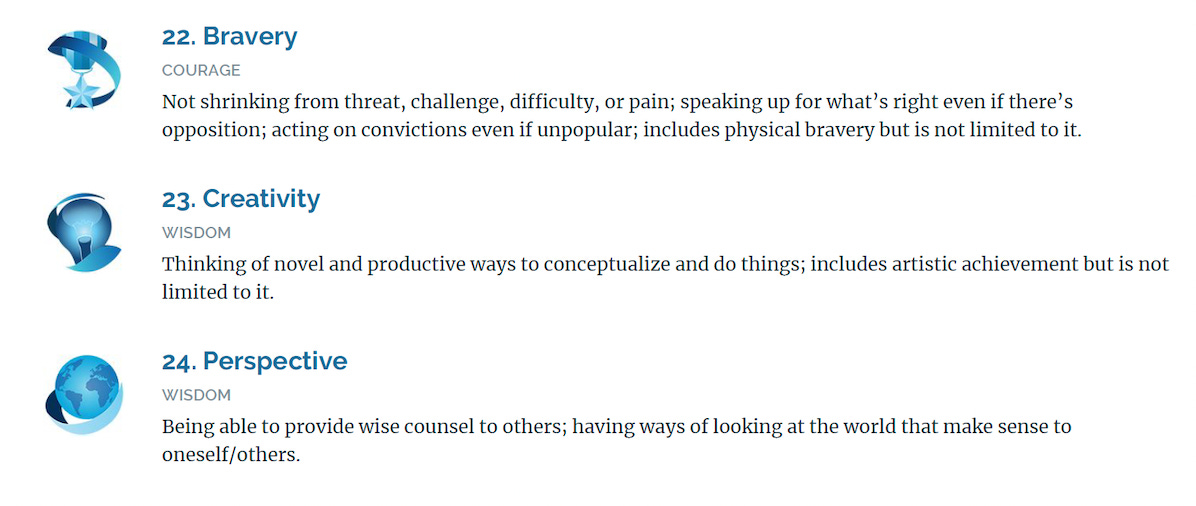
There’s usually one that lands differently. You read the word and something shifts in your chest, not quite pain, more like pressing on a place you’d forgotten was tender. Part resistance, part recognition. The feeling of standing at the edge of something real rather than something irrelevant.
That’s not a warning. That’s the signal. It’s pointing directly at the gap between the identity that got you here and the one that takes you somewhere new.
Most people scroll past it and go back to reinforcing what’s already strong. Which is how you end up very, very good at something and quietly aware that you’re circling the same territory.
The sharper version of the exercise
Here’s where the 20-minute protocol gets more precise.
Instead of writing yourself solving an external problem, write yourself leading with the strength that’s currently sitting near the bottom of your profile. Specifically, in the next real situation where the old version of you would have defaulted to what’s safe.
If bravery is at 22, don’t write a vague scene about being brave in the abstract. Write Thursday’s meeting. The one where someone asks for a volunteer and the familiar tightening starts in your sternum. Write the version of you who says yes before the tightening finishes its sentence. Write what your voice sounds like in that room, steadier than you expected, your shoulders carrying it differently. What does it feel like two minutes later, when the moment has passed and you’re still in the room? Your nervous system is filing something under “familiar.” That’s the whole point.
If self-regulation sits near the bottom and you already know it’s quietly costing you, don’t write yourself as disciplined in general. Write Tuesday morning at 6 AM. East-facing light coming through the window. Your phone is in the other room. You’re at your desk with lukewarm coffee before your brain has started negotiating. Write the specific texture of that version of a Tuesday. The particular quality of that silence before the machinery of reflex kicks in.
If receiving is at 21, and you know it, you know it, write the moment someone says something true about you and you let it land. You don’t deflect. You don’t immediately find the counterexample. You feel the weight of it settle somewhere behind your ribs and you say thank you and mean it and don’t walk it back. Write that scene in as much detail as you can hold.
The specificity is the whole point; your nervous system doesn’t respond to categories. It does responds to scenes.
What this changes
When you run the exercise on an external problem, you’re training your brain to notice solutions. That’s genuinely useful. When you run it on an identity gap, you’re training your brain to recognize itself in a new configuration. Slower to produce, harder to measure in the short term, and the kind of change that doesn’t announce itself until it’s already happened.
The signs tend to be small at first. You notice the old pattern firing a half-second earlier than you used to. You catch yourself doing the thing you wrote before your brain has registered it as out of character. Someone says something about you that matches the scene you wrote two weeks ago and you feel that particular low-key shock of recognition.
This is what Future Scripting is actually for. Not just solving problems, though it does that. Moving the boundary of what you experience as yourself.
Try this tonight
Take the free VIA assessment at What’s Strong if you haven’t. It takes fifteen minutes. When your results come back, read the top five, then keep scrolling to the bottom.
Find the one that presses on something tender. Write its name down.
Then set your timer for 20 minutes and write the scene where you lead with it this week, in the specific situation where the old version of you would have reached for what’s familiar. Present tense, infuse with emotions, and sensory details.
The problem you’ve been trying to solve is probably still worth scripting. But try this one first, and notice what shifts underneath it.
Two weeks from now, someone is going to say something about you that surprises them. You won’t be surprised. You’ll have already written that version of yourself into the room.
The strength you ranked last isn't a weakness. It's an unwritten Future Script. Drop it in the comments below, I read every single one, and watch how many people are sitting at the same edge you thought was only yours.
👉 If you enjoy reading this post, feel free to share it with friends! Or feel free to click the ❤️ button on this post so more people can discover it on Substack.
This so resonates with me. You wrote: “I didn’t write myself solving a funding problem. I wrote myself into being someone who solved problems creatively. The grant appeared because my brain was finally looking for it. But my brain only started looking because I’d spent twenty minutes rehearsing a different version of myself.” This very much reminds me of a story I heard during my psychodrama training, from somebody who trained with Jacob Moreno (the “father” of psychodrama). Moreno, as a young university student in Vienna, was a storyteller. He’d tell stories at a famous park in Vienna, and children would gather and listen—and spontaneously act out the tales. He noticed something important: when a timid child would act out a brave role in the story, that timid child henceforth became less of a timid child, and more of a brave child. The acting-out (or “writing-out”) of a role can change a person. I have seen this profound change over and over again in group psychodrama practice.
I never received the results. Not sure what happened.