

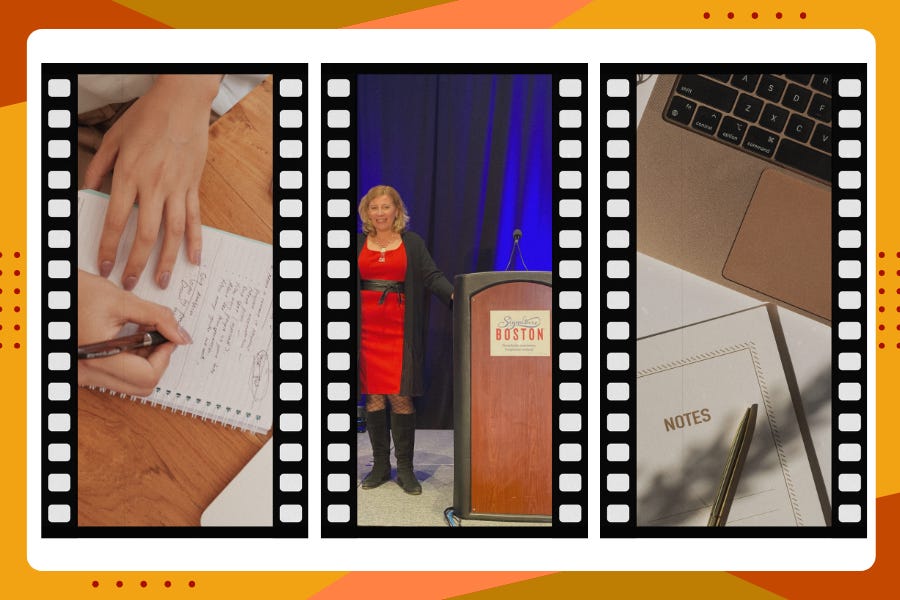
October 2019, Boston. Two minutes before they called my name, the voice in my head was running numbers.
Two thousand people. Two minutes before the accent registers. Half the room gone by minute six. The ones still listening at the end are being polite.
It never called me stupid. It never said I did not belong. It laid out the figures and let me reach the conclusion myself, the way a careful analyst would, and then it stood back while I did the rest of the damage. For twenty years I kept waiting for that voice to sound like an enemy so I would know to fight it. It never did. It sounded like the only reasonable person in the room.
What the record says
I know what I am about to tell you only because at some point I stopped arguing with that voice and started keeping records.
In all the years I have lived and worked in this country, nobody has ever told me they could not understand me. Not in a meeting. Not in a job interview. Not in a conference room at General Motors, where I spent a decade learning the vocabulary of an American company one meeting at a time. Not a client, not a coworker, not the cashier ringing up my groceries. Not once.
What does happen, constantly, is this:
“Sorry, can you repeat that?”
I carried that sentence around for years as evidence against me. It is not evidence of anything. I have heard it from people who have never left their hometown. Most people who say it do not notice they said it, because it is not a verdict, it is how two people keep a conversation moving.
That was the whole disaster I had been rehearsing since I got here at twenty-one without a word of English. Somebody leaning in.
Why encouragement loses
For years I answered the voice the only way I knew how. Belief. Affirmations. A friend gripping my arm in the hallway before a talk: “You’ve got this. They’re going to love you.”
None of it held past the door, and it makes sense to me now. Encouragement arrives as a feeling, and a feeling cannot be checked. The critic arrives with arithmetic. Two thousand seats. Six minutes. Half the room. One of those you can audit at four in the morning when there is nobody awake to hold your arm. The other one evaporates.
Your inner critic accepts one currency, and it is not enthusiasm. It is evidence.
The exercise
Two lines, in pen, on paper. Four minutes.
Line one: what the voice says, word for word. Its language, not your summary of it. Mine, that October, went like this: two thousand people, and half of them will not be able to understand you. They are going to spend the whole talk deciding whether to be patient with the foreigner.
Line two: what has actually happened. Not what should happen. Not what a reasonable person would expect. What has occurred, in real rooms, with real people, as far back as you can remember. Dates if you have them. Names if you have them. If the record is thin, write that it is thin. A thin record is still a record, and it beats a mood.
Then read the two lines side by side. Out loud, if you can stand it.
You are not trying to feel better. You are trying to get the critic and the record into the same sentence, where the critic loses on the merits.
The voice that keeps the record
Do this a few times and you start to recognize who is talking.
The one running the numbers sounds like diligence. It sounds like someone who has done the analysis and would rather spare you the surprise. The one underneath it worries me more, because it does not question my ability, it questions my category. Be serious. We do the work, and somebody who sounds like the room presents it. It speaks gently, the way a friend would, so surrender arrives disguised as maturity. It sat through most of those ten years of meetings with me.
And then there is the voice with no name, the one holding the notebook. It does not tell me I am wonderful on a morning when I am not. It opens to the page and shows me what is written there. The analyst cannot argue with it, because for once the two of them are speaking the same language.
That voice writes line two. It is the only one in the room that has done any homework.
Boston
They called my name and I gave the talk I had given in smaller rooms, on how leaders grow talent inside their own teams.
It landed. People came up afterward, and in the weeks that followed several of them asked me to work with their organizations, to coach their leaders, to build the thing from the inside. I had flown to Boston braced to be tolerated. I flew home with work.
And the fear came back for the next talk. It came back for the one after that.
Boston did not cure anything, and I have stopped waiting for a single room to. What Boston did was go into the notebook. That is how this works. Reinvention is not a breakthrough, it is accumulation, and a notebook is where accumulation becomes visible. All of those voices are still in there. I just know now which one I am feeding.
Tonight
Take a pen. Write down what your critic says, in its exact words.
Tomorrow morning, before the house wakes up, write underneath it what has actually happened, on the record, every time.
Two lines. The first one is the story. The second one is the evidence. You will be surprised how rarely they match.
Four minutes tonight is a line. Four minutes a week for a year is a case.
Which voice is running the numbers on you right now, and what exactly is it saying? Drop it in the comments below, I read every single one
👉 If you enjoy reading this post, feel free to share it with friends! Or feel free to click the ❤️ button on this post so more people can discover it on Substack.
P.S. If you want to run this on more than one voice, I built a self-guided 21-day challenge around it. Three weeks on Time, Love, and Money, twenty minutes a day, everything unlocked the moment you join. Rewrite Your Limiting Beliefs, Before They Rewrite You.
I really liked the distinction between encouragement and evidence. Reassurance can disappear so quickly, but it is much harder for the inner critic to argue with a clear record of what has actually happened. I think the harder part is continuing to return to the evidence when the same fear comes back, instead of expecting one good experience to silence it for good.
That is almost a textbook memory consolidation practice. Love it!