

She said his name at breakfast, casually, the way you ask about someone whose face you have half-remembered. I had never told her about him. The only place his name existed in my life was a notebook I kept in Polish, written by flashlight before dawn, in handwriting that only comes out when you are writing for nobody.
My stomach dropped before my brain caught up. She had read it. Three months earlier, possibly more. All of it. That week, I closed the notebook. The next time I opened one with the intention of being honest in it, I was forty-seven.
The boy who got the rescue I needed
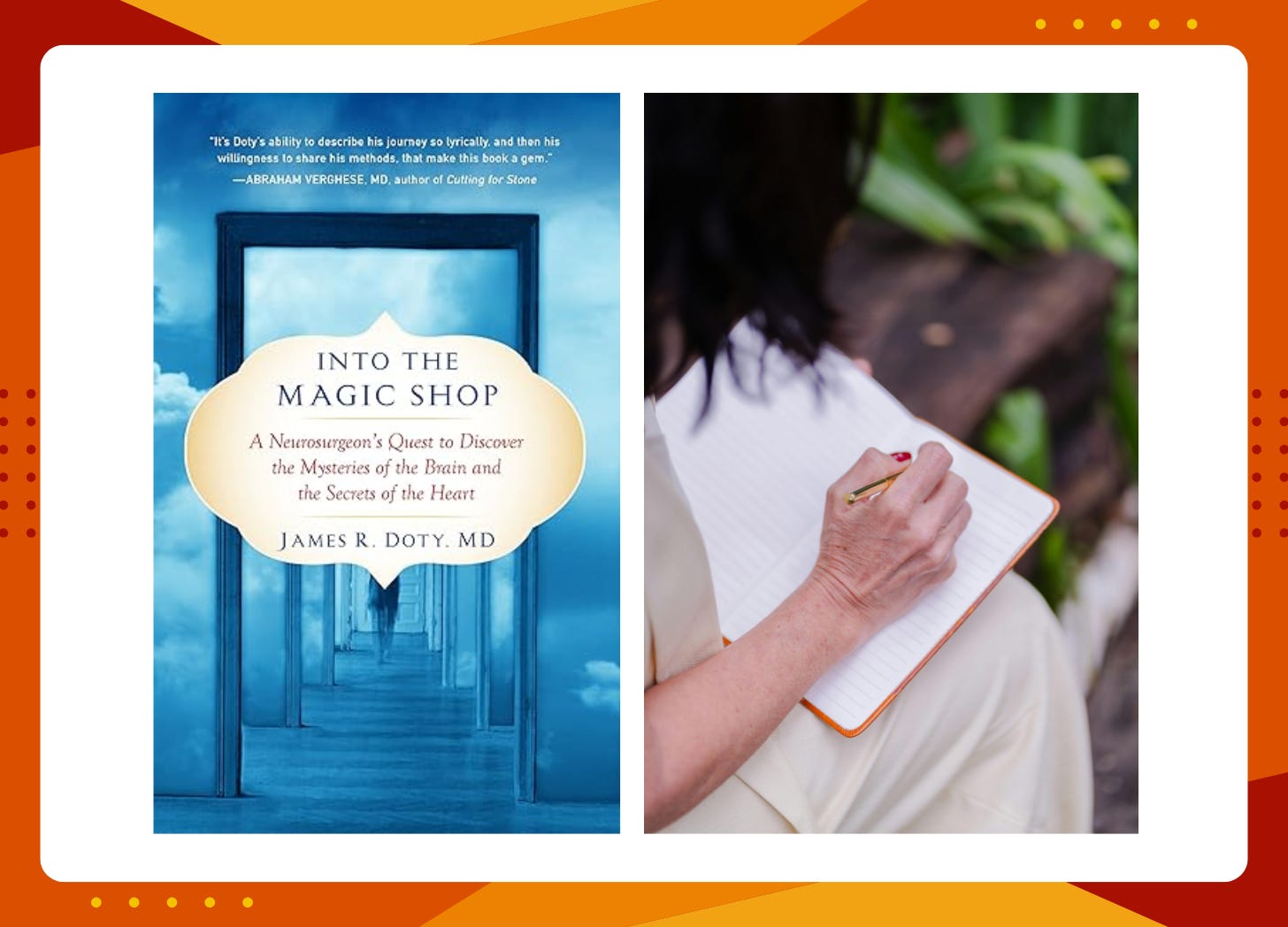
Jim Doty was twelve when he walked into a magic shop in Lancaster, California, and the woman behind the counter, a stranger named Ruth, taught him four practices over six weeks. Settle the body. Quiet the head. Open the heart. Write down, in specific detail, the person you want to become. He went home each afternoon to a mother who could barely get out of bed and a father whose drinking shaped every dinner, and he practiced anyway. He grew up to be a Stanford neurosurgeon. In the book he wrote about those six weeks, Into the Magic Shop, he says nothing he became would have been possible without them.
I read it in my forties. The boy on the first page felt familiar before I understood why.
He and I had needed the same thing as children. Only one of us got it.
What the body learns
Jim and I came out of childhood with a body that had learned a specific lesson about honesty. His was taught by Ruth’s hand on his shoulder, six weeks in a row, that an interior could be safe. Mine was taught at a kitchen table by the person whose voice my nervous system was wired to listen for above all others.
For those of us who lost the page somewhere along the way, the road back is longer than people understand. It is not a productivity problem. It is a body problem. The hand has to be taught, slowly, that it is safe to move again.
The practice Doty almost skipped
Doty followed Ruth’s first three practices well enough to build everything he had written down at twelve. He skipped the heart-opening. Years later, the life he had built came apart, and he has said in print that the collapse was the best thing that ever happened to him, because it forced him back to the only practice that actually mattered.
I have seen the version he is warning about. A page covered in clean ambitious sentences, the title of the role at the top, the salary number underlined twice, the city named, the apartment described down to the kitchen tile. No mention of a single person. No mention of who she would have to become to live there. No mention of what she would forgive herself for on the way.
That kind of writing is a delivery mechanism with no destination.
The thirty years between
The thirty years between my journal at seventeen and my notebook at forty-seven were not wasted, even though they felt like it. Most of those years were the slow work of teaching a nervous system that the page was safe again.
The first thing that moved the dial was a letter I wrote in my backyard with the explicit intention of burning it. I wrote what I needed to say, walked outside, and watched it turn to ash. The point was not the content. It was teaching my body, in a way it could feel, that a true sentence in this new life would not cost me anything.
I had to prove that more than once. I still slip into Polish when the thing I want to write feels too tender for English, because Polish is where the seventeen-year-old still lives, and she needs to be the first one to read it.
When the Tuesday morning came and I sat down with a notebook and wrote my way into a future where our nonprofit had already found its funding, the exercise worked because of the years of small repairs nobody saw. Ruth’s first practice. My letter in the backyard. Same instruction, different teachers.
If you are her
You do not have to start with the future yet. You can start with a sentence you do not intend anyone to read, written on a page you can burn afterward if you want to.
Notice what your shoulders do when you write the true version. That is the practice. That is the whole first practice, and it is the one I wish someone had told me comes before all the rest.
Your pen is your permission slip. It always was.
If there is a sentence you have been carrying that you have never written down, you can leave it in the comments, and I will read every one.
With love, Magdalena
👉 If you enjoy reading this post, feel free to share it with friends! Or feel free to click the ❤️ button on this post so more people can discover it on Substack.


I loved reading this, Magdalena. It reminded me of my own passion to write from the heart, without any concern about the outcome. Just for the sake of writing my heart out. It’s been difficult to find my way back there but I’m inspired by your article. Let’s see what happens✨
Wow, Magdalena. I really resonated with this & your beautiful story. I also felt this amazing feeling like “oh I wish I’d had Doty’s experience, too!”
And it feels like synchronicity. Because I just gave my very 1st interview on Substack and I talked about my similar experience here https://unfilteredpagess.substack.com/p/in-a-coversation-with-marisa-victus?r=39jkyq&utm_medium=ios
I said, “the act of creative writing is my own form of self-advocacy. For the longest time, I separated this aspect of myself when I became an Attorney. For years, I didn’t write any fiction. My art practice was non-existent. And my music fell by the wayside. I felt like a large part of me was lost, as I had shattered, and I even had people who tried to dissuade me from creative writing and publishing books. For a long time, I did do that. I followed their advice, and I focused on purely practicing Law, but ultimately, I felt my true, Authentic Self fracture because I was unwilling to bend the so-called “rules” and allow myself to honor every aspect of who I am. I was suppressing who I truly was by denying and hiding the Creative inside of me.
Until I finally realized, “I need to advocate for myself.” That’s why the lawyer in me shows up a lot when I’m writing fiction. She helps me to see that I’m choosing myself when I write these words, when I create these stories, when I publish these books, when I make art and music, when I share them with the world.
All of it’s been a labor of love, sweat, & tears, not only because of the creative work itself, but what it means to me…. personally…. as proof that I am championing my Creative Self and finally allowing her to be seen. And it’s a relief…. to heal the disconnection I used to feel inside. I’m nowhere close to the finish line, but I’m so much happier and full of passion and purpose now that I’m on the right path: Walking my own Attorney-to-Creative Journey, as I like to call it.
And it’s worth it. The pain in my past serves a purpose. Because now I’m devoted to not only pursuing my own creative work and honoring my true Authentic Self, but I’m also passionate about encouraging others to explore their own creativity & honor their true Authentic Self, as well.”